Sharing the road with large trucks comes with hidden dangers. Trucks have blind spots that stretch far beyond what most drivers expect, where entire cars can vanish from view.
While a truck prepares to change lanes without seeing you, you might be driving safely on I-287, thinking you’re visible. These areas, called "no-zones," surround trucks on all sides. The front, back, and right side of a truck hide vehicles for long distances, and even the left side can conceal cars in adjacent lanes.
When drivers fail to account for these zones, serious accidents happen. If a truck’s blind spot causes injury on the Cross Bronx Expressway or elsewhere in New York, the truck accident attorneys in Manhattan, NYC, at the Law Offices of Jason B. Kessler can guide you through your car accident claim.
Key Takeaways: The Hidden Dangers of Truck Blind Spots
- Truck blind spots are exponentially larger than cars: Commercial vehicles have no-zones where entire passenger vehicles disappear completely from the driver's view, even with properly adjusted mirrors.
- The right side creates the most dangerous blind spot: Trucks have virtually no visibility along the right side, making right-side merges and lane changes especially hazardous for nearby vehicles.
- Mirrors alone cannot eliminate blind spots: Even perfectly positioned mirrors leave significant areas around trucks where drivers cannot see adjacent traffic without additional technology or physical head checks.
- Driver training often inadequately addresses blind spots: Some trucking companies fail to properly train drivers on checking blind spots thoroughly before maneuvers, creating preventable accident risks.
- Passenger vehicle drivers contribute by lingering: Many drivers don't understand truck blind spots and travel in no-zones for extended periods, putting themselves at risk when trucks maneuver.
- Available technology can prevent many accidents: Side-view cameras, blind spot monitoring systems, and collision avoidance technology exist, but aren't universally required or implemented across the trucking industry.
- Call a truck accident lawyer immediately: Blind spot accidents often involve disputes about who saw whom and whether drivers exercised proper caution, requiring thorough investigation and a skilled truck accident attorney.
How Truck Design Creates Massive Blind Spots
Commercial trucks prioritize hauling maximum cargo efficiently over providing optimal visibility. This functional priority creates inherent visibility problems that no amount of mirror adjustment can fully solve.
The tractor-trailer configuration itself generates blind spots that simply don't exist in passenger vehicles. The truck cab sits high above the road, providing commanding views ahead but creating a significant blind spot immediately in front of the vehicle.
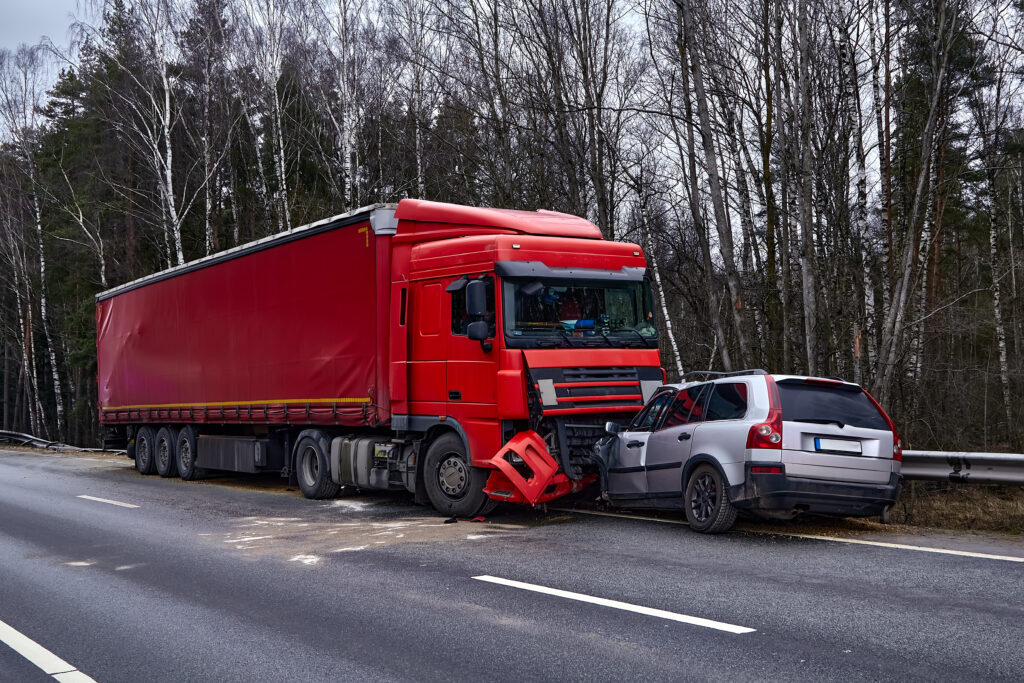
Cars traveling directly ahead of the truck can disappear entirely from the driver's view. This front blind spot extends approximately 20 feet, meaning an entire vehicle can be invisible to the trucker bearing down on stopped traffic.
Drivers have virtually no direct visibility behind the trailer. Standard mirrors show some area behind the truck, but the trailer's length creates a massive blind spot extending 30 feet or more. Vehicles traveling directly behind trucks are invisible to the driver, who cannot know whether someone is following too closely or attempting to pass.
Why the Right Side Presents the Greatest Danger
The right side of a commercial truck presents the largest and most dangerous blind spot. This no-zone extends along the entire length of the trailer and several lanes to the right. Even with properly adjusted mirrors, a truck driver cannot see vehicles traveling beside or slightly behind their passenger-side door.
This right-side blind spot causes numerous accidents when trucks make right turns, change lanes to the right, or merge onto highways. The driver checks their mirrors, sees nothing in the limited area they can view, and begins maneuvering, unaware that a car is traveling alongside the trailer in the massive blind spot.
Trucks making right turns in Manhattan, Queens, or any urban environment face particular challenges. The vehicle must swing wide to complete the turn, and the trailer follows a different path from the cab. When the trailer swings through a turn, it can crush pedestrians, cyclists, and cars on the truck’s right side.
Driver Training Failures That Lead to Blind Spot Accidents
Federal regulations require commercial driver training, but the quality and comprehensiveness of that training vary dramatically across the industry. Some trucking companies invest in extensive training programs that prepare drivers for real-world challenges.
Others rush operators through minimal requirements to get them on the road quickly, creating dangerous gaps in skills and knowledge. Proper blind spot management requires more than just checking mirrors before changing lanes. Drivers must physically lean forward and turn their heads to check blind spots that mirrors cannot cover. They need to understand exactly where their blind spots are and develop habits that account for these limitations in every maneuver. Many truck drivers never receive adequate training on blind spot awareness.
Drivers learn to check their mirrors but don’t receive training on the techniques needed to cover the areas mirrors miss. They don't learn to anticipate where passenger vehicles might be hiding or how to scan systematically to catch vehicles in blind spots before maneuvering.
Trucking companies create economic pressure for drivers to make quick lane changes, complete turns efficiently, and maintain schedules that leave little room for extra safety checks. This pressure conflicts with the time required to properly check all blind spots before every maneuver.
A thorough blind spot check takes several seconds—time that drivers feel they don't have when trying to merge onto a crowded highway or navigate through congested New York City traffic. The pressure to move quickly leads to shortcuts in safety procedures, and those shortcuts result in accidents when vehicles occupying blind spots get sideswiped, crushed, or forced off the road.
Mirror Limitations and Adjustment Problems
Commercial trucks rely on multiple mirrors to see around the vehicle. Side-view mirrors show the trailer’s sides, while convex mirrors provide wider angles, and some trucks have additional mirrors or cameras.
Even perfectly adjusted mirrors cannot eliminate blind spots, as the size and angles of a 53-foot trailer leave significant areas invisible. Many drivers set their mirrors incorrectly, revealing more of the trailer than the lanes beside them.
Vibration during driving blurs images, especially on rough New York roads. Rain, snow, road spray, frost, and ice further reduce visibility, distorting or blocking mirrors and creating dangerous conditions. Drivers often make lane changes or turns despite these limitations. We at the Law Offices of Jason B. Kessler work to hold drivers and trucking companies accountable when poorly maintained or improperly used mirrors contribute to preventable accidents across New York.
Common Blind Spot Accident Scenarios
Certain accidents happen repeatedly because they stem from truck blind spot risks rather than unusual events. Lane change collisions occur when trucks move into spaces occupied by vehicles the driver cannot see, often pushing smaller cars into barriers or other lanes.
Merge accidents happen when trucks enter highways and fail to notice vehicles already traveling in the lane, forcing sudden braking, swerving, or collisions. Right-turn accidents are especially deadly, crushing vehicles, pedestrians, or cyclists as trucks swing wide and trailers cut inward.
These crashes often occur at intersections in Manhattan and Queens, where tight streets and stopped traffic put people directly in blind spots. We at the Law Offices of Jason B. Kessler work to hold drivers and trucking companies accountable for these preventable accidents and protect New Yorkers who suffer serious injuries.
Passenger Vehicle Contributions to Blind Spot Accidents
Truck drivers are responsible for checking blind spots and maneuvering safely. Still, passenger vehicles sometimes increase risks by lingering in no-zones, passing on the right, or squeezing past turning trucks.
Many drivers underestimate the size of truck blind spots and travel alongside trailers for miles without realizing the truck cannot see them. Aggressive actions, such as cutting closely in front of a truck after passing, create dangerous moments when collisions become likely.
A common misconception is that if drivers see the truck’s mirrors, the truck can see them, but mirror angles often leave vehicles invisible. Education can help car drivers avoid no-zones, yet truck drivers still hold the primary duty to prevent accidents.
How Weather and Time of Day Increase Blind Spot Risks
Environmental conditions can make blind spots even more dangerous for truck drivers. Nighttime driving reduces visibility, and dark-colored vehicles can disappear in mirrors. Rain distorts mirrors, road spray blocks views, and judging distances becomes harder.
Snow and ice worsen these risks, creating whiteout conditions or freezing mirrors, while slippery roads make accidents more severe. Transitional lighting, like sunrise or sunset, can blind drivers and hide vehicles in blind spots, yet these hazards often go unaddressed.
Trucking companies must train drivers to manage these challenges, such as pausing for better angles, using alternative checks, and exercising extra caution when visibility is poor.
Investigation Challenges in Blind Spot Accident Cases
Proving what happens in blind spot truck accidents can be difficult because the facts often come into dispute. Drivers may claim they checked mirrors and saw nothing, while victims say they were visible and the truck moved without warning.
Physical evidence like vehicle damage, final positions, and debris patterns helps reconstruct the crash. Witnesses can verify whether the driver used signals or skipped safety checks. Modern trucks record speed, braking, turn signals, and steering data, which can show whether a driver acted appropriately.
Evidence vanishes quickly if you don’t preserve it, as trucks get repaired and data overwritten. Acting quickly is crucial. We help preserve vehicles, electronic records, documents, and interview witnesses while memories are fresh, ensuring nothing critical is lost.
Liability in Blind Spot Truck Accidents
Determining responsibility in blind spot truck accidents means looking at what everyone did or failed to do. Truck drivers carry higher duties because they operate commercial vehicles and must meet stricter safety standards.
Failing to check blind spots before turning or changing lanes puts others at serious risk. Trucking companies can share liability when poor training, unrealistic schedules, or a lack of safety technology contribute to crashes.
Some accidents stem from inadequate mirrors, cab designs that worsen visibility, or truck features that ignore known blind spot dangers. Manufacturers may face accountability if safer designs prevent the harm. These cases are complex, but we focus on holding drivers, companies, and manufacturers responsible.
How New York Courts Handle Blind Spot Accident Cases
In New York, juries examine blind spot truck accidents closely, focusing on whether drivers took proper care given the known visibility limits. Truck drivers must check mirrors, turn to look, use cameras or monitoring systems, and give themselves enough time before changing lanes or turning.

Passenger vehicles sometimes share responsibility if they linger in blind spots or move dangerously around trucks. Still, truck drivers' larger size, weight, and professional duties usually place most of the fault on them.
Accidents in Queens, Manhattan, and across New York often cause catastrophic injuries, leaving victims feeling helpless. Trucking companies face accountability when they fail to train drivers, enforce safety protocols, or utilize available technology.
Securing Justice After Blind Spot Truck Accidents
Commercial trucks have hidden dangers that can cause life-changing accidents on New York roads. Many of these crashes happen because companies ignore safety measures that can prevent them, putting profits over lives. If a truck driver didn’t see you in a blind spot, and you suffered an injury, you need more than sympathy—you deserve full compensation for medical bills, lost income, and the impact on your life.
The Law Offices of Jason B. Kessler, a personal injury lawyer in Manhattan, NYC, can help investigate your accident, prove trucking company negligence, and fight for maximum compensation. Serving the New York City area, we’re ready to support you. Call 914-220-1088 to discuss your case.
FAQs About Truck Blind Spot Accidents
Where exactly are truck blind spots located?
Trucks have blind spots extending approximately 20 feet in front, 30 feet behind, along the entire right side, and for several lanes on the left side, the right side presenting the largest and most dangerous no-zone.
Can truck drivers see me if I can see their mirrors?
No, seeing the truck's mirrors doesn't mean the driver can see you in those mirrors due to reflection angles and limited fields of view, making this a dangerous assumption many car drivers make.
Is the trucking company liable if their driver couldn't see my car?
Yes, blind spots don't excuse truck drivers from ensuring areas are clear before maneuvering, and companies are liable when inadequate training or failure to implement safety technology contributes to accidents.
What evidence proves the truck driver didn't check their blind spot?
Electronic truck data showing speed and steering patterns, witness testimony, damage patterns, lack of braking before impact, and the driver's own statements all help prove that inadequate blind spot checking caused the accident.